
Priority item Compliance Standards
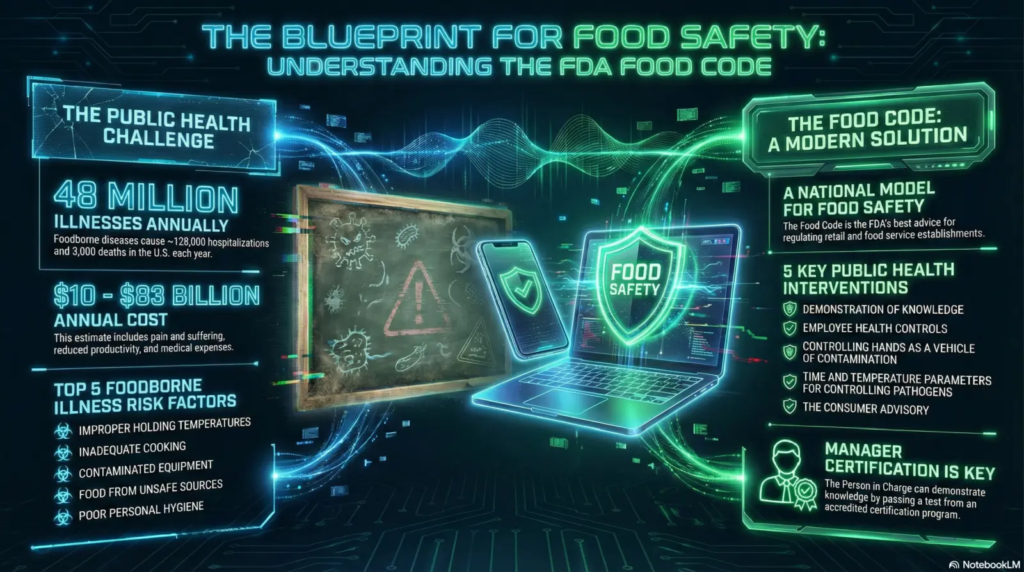
Maintaining compliance with the FDA Food Code requires more than just basic knowledge; it requires a deep understanding of items that directly impact food safety. A **Priority item** is defined as a provision whose application contributes directly to the elimination or reduction of hazards to an acceptable level. Because there is no other provision that more directly controls the hazard, these are the most critical points of inspection. For example, ensuring that poultry reaches an internal temperature of 165°F is a quantifiable Priority item.
In contrast, a **Priority Foundation item** supports or enables these primary goals. For instance, having a calibrated food thermometer is a Priority Foundation item because it enables the manager to verify the Priority item (the actual cooking temperature). To meet these rigorous FDA mandates, restaurant managers must pass an ANSI-accredited exam. Our programs are overseen by Manny Campos, a nationally recognized Food Managers Certification (FMC) Proctor (ID: EDUPR-111709), authorized in all 50 states. This oversight ensures that your training is aligned with the highest national standards for food protection.
Valid Food Manager Certification in All 50 States
Navigating the various state and local health department requirements can be daunting. However, because our training is based on the unified FDA Food Code and overseen by an accredited proctor, the knowledge gained is universally applicable. Whether you are operating in California, Texas, New York, or Florida, the core principles of hazard control remain the same. Achieving your Food Protection Manager certification through an ANAB-CFP accredited program ensures your credentials move with you, providing professional mobility and regulatory peace of mind.
Food Safety
Official Training Credentials:
- ✓ Registered Provider: ACE Restaurant Manager Training
- ✓ Standard: EDUProctor
- ✓ License: EDUPR-111709
- ✓ Training: Nationally Accepted Certification
Frequently Asked Questions
A1: No, this product is a comprehensive training and exam preparation course. It is designed to prepare you for any ANAB-CFP accredited exam (such as FMC, ServSafe, or NRFSP). Because our lead proctor, Manny Campos (ID: EDUPR-111709), maintains strict compliance standards, we provide this training to ensure you have the universal foundation needed to pass your proctored exam at any testing center nationwide.Q2: How do the AI Study Tools help me pass the Food Manager exam?
A2: Our course is powered by the “Kitchen Brain” Study Suite, which includes AI-generated flashcards, adaptive practice tests, and audio summaries. These tools allow you to drill key FDA Food Code temperatures and regulations on your mobile device. By combining Manny Campos’s proctoring expertise with next-gen technology, we help you learn faster and retain more information than traditional textbooks allow.Q3: Is the training based on the most current FDA Food Code?
A3: Yes. This course is built strictly on the current national FDA Food Code standards. Unlike outdated training materials, our curriculum is updated to reflect exactly what health inspectors are looking for today. As an approved FMC Proctor (License: EDUPR-111709), Manny Campos ensures that all course content meets the rigorous requirements for national Food Protection Manager certification across all 50 states.